
What is Mutual Funds? Asset Management Company How does a Mutual Fund Work? Classification of Mutual Funds Classification - Based on Structure Classification - Based on Investment Objective Classification - Based on Investment Style Categorization of Mutual Fund Schemes How to invest in Mutual Funds? Centralized KYC (C-KYC) in Securities Market Mutual Funds investment procedure Investment Modes in Mutual Funds Mutual Fund Plans – Growth vs Dividend Options How to check information about the Mutual Funds? Risk-o-Meter and its importance

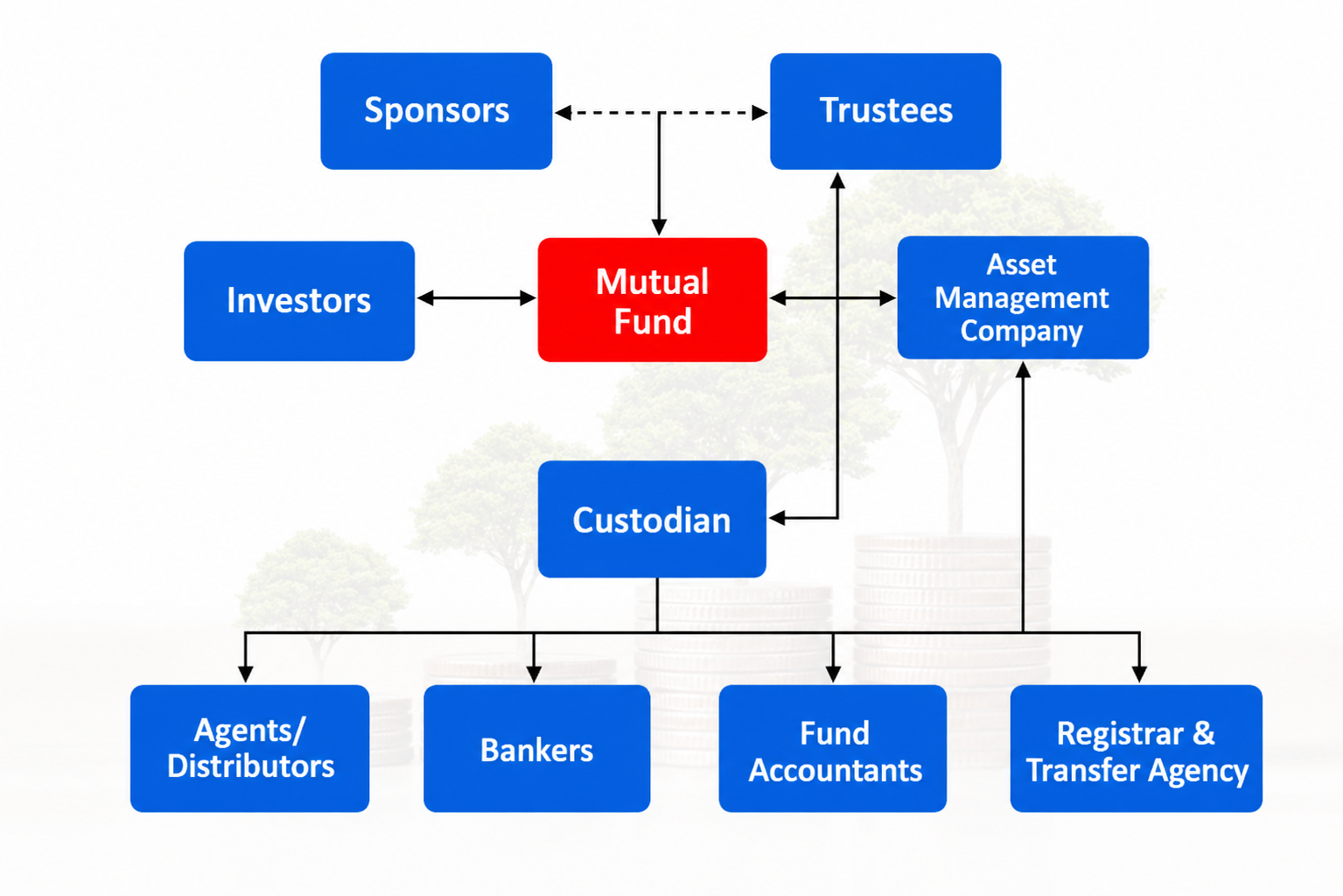
What is Mutual Funds?

01
Common pool of funds contributed by investors and invested in accordance to the objectives.
02
Investments are held in a trust of which the investors alone are the joint beneficial owners.
03
Trustees oversee the management by investment manager.

What is an Asset Management Company (AMC)?

AMC
01
Investment manager of the mutual fund.
02
Appointed by the trustees, with SEBI approval.
03
Trustees and AMC enter into an investment management agreement.
04
Required to invest seed capital of 1% of amount raised subject to a maximum of Rs.50 lakh in all open-ended schemes.
05
Should have a net worth of at least Rs.50 crore at all times.
06
At least 50% of members of the board of an AMC have to be independent.
07
AMC of one mutual fund cannot be an AMC or trustee of another fund.
08
AMCs cannot engage in any business other than that of financial advisory and investment management.

How does a Mutual Fund Work?

👥
Investors
⚙️
Fund Managers
📈
Stock / Securities
Returns
👥
Delivered to Investors
  1. Pool of investors money.
  2. Invested according to pre-specified investment objectives.
  3. Benefits accrue to those that contribute to this pool.
  1. There is thus mutuality in the contribution and the benefit.
  2. Hence the name 'mutual' fund.
AMC

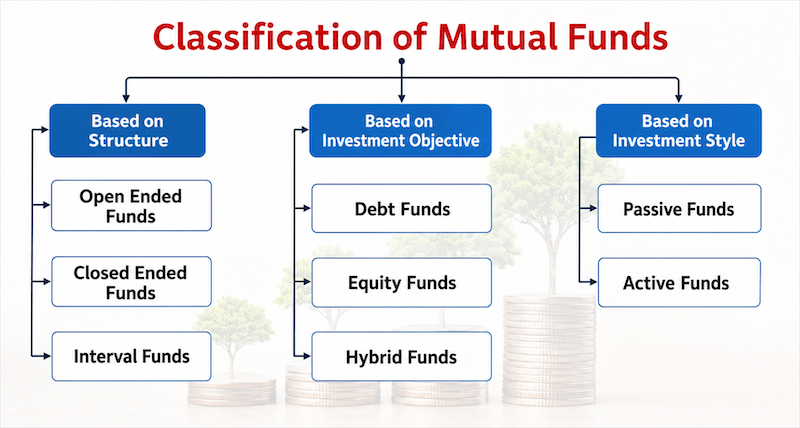
Classification – Based on Structure

Open Ended
Funds
  1. No fixed maturity date.
  2. Accept continuous sale and re-purchase requests.
  3. Transactions are NAV-based.
  4. Unit capital is not fixed.
Closed Ended
Funds
  1. Run for a specific period.
  2. Offered in an NFO but are closed for further purchases after NFO.
  3. Unit capital is kept constant.
Interval
Funds
  1. Variant of closed-ended funds.
  2. Becomes open-ended at specific intervals.
  3. Have to be mandatorily listed.

Classification – Based on Investment Objective

Debt
Funds
  1. Invest in short and long term debt instruments.
  2. Aim to provide regular income.
Equity
Funds
  1. Invest in equity securities.
  2. Aim to provide growth and capital appreciation over long term.
Hybrid
Funds
  1. Invest in a combination of equity and debt securities.
  2. Proportion of equity and debt may vary.
  3. Aim to provide for both income and capital appreciation.

Classification – Based on Investment Style

Passive
Funds
  1. Replicate a market index.
  2. Invest in same securities and in same proportion as that of index.
  3. No active selection of any stock / sector. Expenses are lower.
  4. Portfolio is modified every time index composition changes.
Active
Funds
  1. Invests in securities and sectors that may offer a better return than the index.
  2. Actively manage the allocation to market securities and cash.
  3. May perform better or worse than the market index.
  4. Incur a higher cost than passive funds.

Categorization of Mutual Fund Schemes

Categorization of open-end mutual funds:

— To ensure uniformity in characteristics of similar type of schemes launched by different mutual funds.

— Helps investors to evaluate different options available before making informed decision to invest.

📊
Equity
Schemes
🧾
Debt
Schemes
♟️
Hybrid
Schemes
🕐
Solution Oriented
Schemes
🖥️
Other
Schemes

How to invest in Mutual Funds?

Via Physical
Mutual Fund
Application Form
Via Online Mode
(Website of
Mutual Fund)
Via Mobile App of
Mutual Fund
Via AMFI Registered
Mutual Fund Distributor
(using physical form /
online / mobile app)

Centralized KYC (C-KYC) in Securities Market

KYC registration is centralized through KYC Registration Agencies (KRAs) registered with SEBI.

Each investor to undergo KYC process only once in securities market and details would be shared with other intermediaries by the KRAs.

Standard Account Opening form (AOF) has 2 parts:

Part I : Basic and uniform KYC details of the investor.
Part II : Additional KYC information as may be sought separately by the Mutual Fund.

Mutual Funds Investment Procedure

Indicate whether you are a First Time Investor / Existing Investor.
Visit official website of KRA and check whether you are KYC compliant or not. You must submit this KYC status.
Provide your details like name, address, etc.
Submit Bank account details and copy of "Cancelled Cheque".
Once documents are accepted by Mutual Fund Company, you may start making investment.

Investment Modes in Mutual Funds

Direct Mutual Fund
  • Directly offered by fund house.
  • No involvement of third party agents & brokers or distributors.
  • No commissions and brokerage.
  • Have low Expense ratio (because of no commissions).
  • Have high NAV.
  • Return is higher due to a lower expense ratio.
Regular Mutual Fund
  • Bought through an intermediary.
  • Intermediaries can be brokers, advisors or distributors.
  • Commissions and brokerage paid.
  • High Expense ratio as there are commissions to pay.
  • Low NAV.
  • Return is lower due to a higher expense ratio.

Mutual Fund Plans – Growth vs Dividend Options

Growth
Option
  1. Gains made in portfolio are retained and reflected in NAV.
  2. Realized profit/loss is treated as capital gains or loss.
  3. No increase or decrease in number of units, except if units are purchased or sold by the investor.
Dividend
Payout
Option
  1. Fund declares dividend from realized profits.
  2. Amount and frequency varies and depends upon distributable surplus.
  3. NAV falls after dividend payout to the extent of dividend paid.
Dividend
Reinvestment
Option
  1. Dividend is re-invested in same scheme by buying additional units at ex-dividend NAV.
  2. Number of units standing to the credit of the investor increases each time a dividend is declared, and reinvested back into the scheme.

How to check information about the Mutual Funds?

Statement of
Additional
Information
(SAI)
  1. Contains generic and statutory information of mutual fund.
  2. Contains financial information of mutual fund.
  3. Lays down rights of investor.
  4. Other additional information.
Scheme
Information
Document
(SID)
  • Scheme type (open or closed end).
  • Investment objective.
  • Asset allocation.
  • Investment strategies.
  • Terms with regard to liquidity.
  • Fees and expenses.
  • Other information relating to the scheme.

Risk-o-Meter and its importance

LOW LOW TO MODERATE MODERATE MODERATELY HIGH HIGH VERY HIGH
LOW VERY HIGH

Six levels of risk for mutual fund schemes:

  1. Low Risk
  2. Low to Moderate Risk
  3. Moderate Risk
  4. Moderately High Risk
  5. High Risk
  6. Very High Risk

Importance of Risk-o-meter:

— Helps align risk that a fund carries with the risk profile of the investor.

Equity as asset class: Volatile → High risk

Debt as asset class: Stable → Low risk

Hybrid: Moderate → Depends on allocation and concentration